


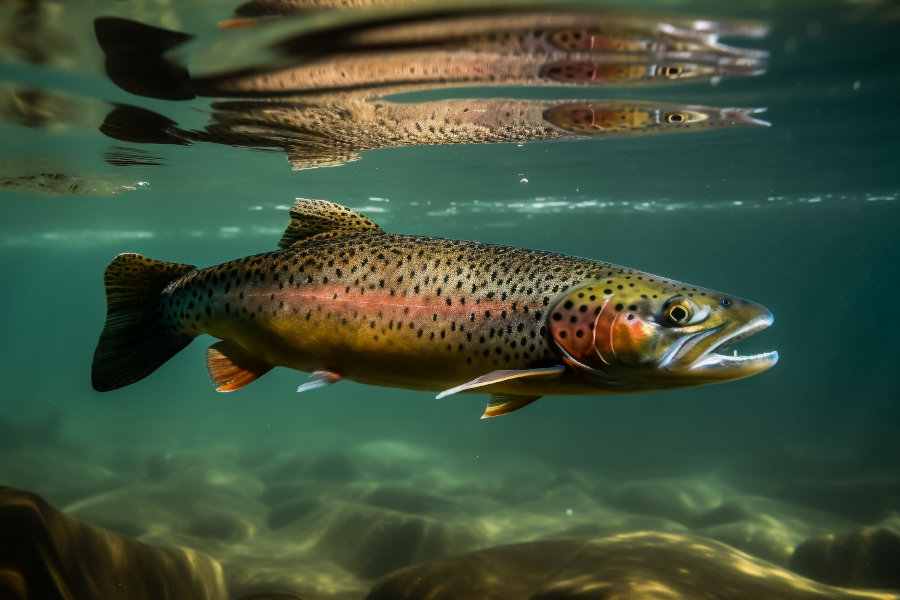
Chile is one of the world’s largest producers of rainbow trout. However, the emergence and spread of diseases caused by pathogens such as bacteria, fungi, parasites, and viruses can can result in significant losses for the aquaculture industry.
Among these viral infections, infectious pancreatic necrosis (IPN) has become the leading cause of disease-related mortality in the species. According to Sernapesca’s health report for the 2021–2023 period, the virus shows an average incidence rate of 19.9% in seawater farms and 20.18% in freshwater facilities.
Although producers have implemented various strategies to prevent and combat IPNV—including traditional vaccines and antivirals—these treatments have failed to achieve expected efficacy, making new scientific solutions urgent.
In this context, the University of Santiago de Chile brings a strong track record in basic and applied research to solve aquatic health challenges. As part of this initiative, the university is currently executing the R&D project “Analysis of the Role of Long Non-coding RNAs (lncRNAs) in the Interaction Between Global Warming and the Response to Infectious Pancreatic Necrosis Virus (IPNV) in Rainbow Trout Aquaculture.”
The study is led by Ph.D. candidate Francisca Madrid Silva and Dr. Rodrigo Vidal Soto, a researcher and director of the Genomics Laboratory at USACH's Faculty of Chemistry and Biology. The project is funded by ANID in collaboration with industry partner Caleta Bay, alongside support from VRIIC’s Technology Management Office.
“Our goal is to understand how rising sea temperatures, driven by climate change, influence the regulatory response of non-coding RNA in rainbow trout exposed to IPNV. This virus severely damages fish health—especially during fry and juvenile stages—and leads to high mortality rates,” notes Francisca Madrid.
Genomic Research
To address this challenge, the team will focus its work on the study of under-explored genes known as long non-coding RNAs (lncRNAs).“They represent the ‘dark matter’ of the vertebrate genome and play a key role in the activation and/or deactivation of genes and proteins,” explains Dr. Vidal.
He adds that experimental trials will be conducted at different temperatures to analyze the species’ genetic material and assess how their response to the virus changes.
The project is scheduled to last two years. During the first stage, at the laboratory level, infected fish at the fry stage will be studied under different temperature conditions.
“After this phase, we will extract RNA and sequence it to construct genomic libraries for analysis. Subsequently, these findings will be experimentally validated in real-world conditions alongside our partner company,” says the researcher.
Collaboration with Industry
Caleta Bay is one of Chile’s leading rainbow trout producers and is known for fostering a culture of ongoing research and development, alongside sustainable farm management. In this regard, the researcher notes that the company has “the lowest rate of antibiotic use and the lowest mortality rate.”
Both researchers agree that this joint effort between academia and the private sector represents a concrete opportunity to generate knowledge with real-world impact.
“This has many positive impacts, because it allows laboratory research to be transformed into a real solution to a specific problem within the field of biological science,” says Francisca Madrid.
Dr. Rodrigo Vidal explains that one of the main expected outcomes is “to generate genomic information on the resilience of rainbow trout, which will enable the partner company to strengthen genetic management and production strategies in the face of climate change.”
He also emphasizes that the initiative will not only strengthen the partnership between the university and industry but will also bring innovation to the national aquaculture sector, where one of the major challenges is no longer to produce more, but to produce better.
“And that ‘better’ must be achieved within an optimized cycle—that is, being able to complete production cycles at a low cost,” the scholar points out.