


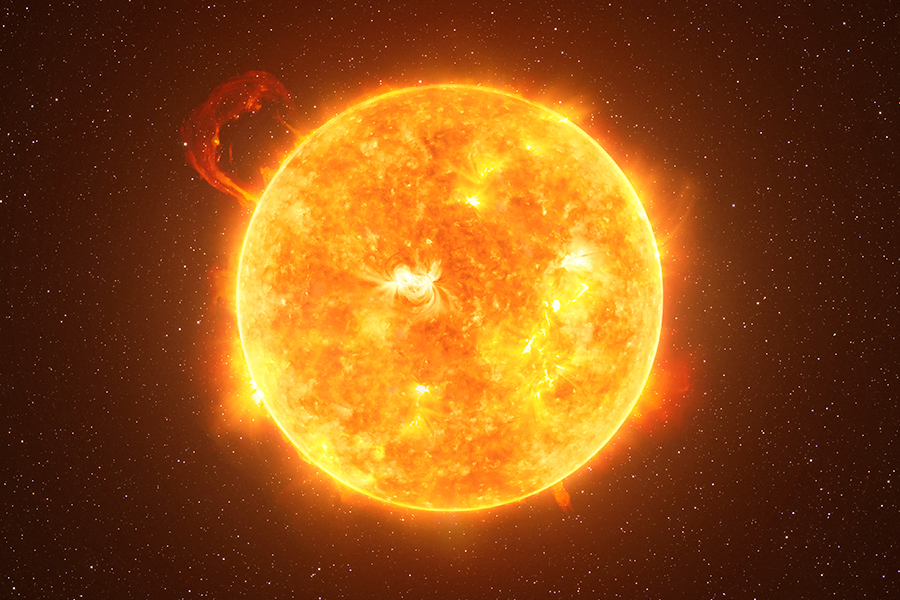
Industries such as transportation, logistics, mining, fishing, and agriculture rely heavily on satellite connectivity and Global Navigation Satellite Systems (GNSS), where geolocation accuracy is vital for operations. However, these technologies are vulnerable to solar activity, which can trigger disturbances leading to significant positioning errors, communication outages, or failures in critical infrastructure.
While Chilean scientific teams have researched these phenomena for years, the country currently lacks the technology to generate the localized predictions and early warnings needed to mitigate these effects in a timely manner.
In response, the University of Santiago de Chile (Usach) is developing the Fondef project, “Development and Implementation of a Space Meteorology Platform in Chile.” Dr. Marina Stepanova and Dr. Víctor Pinto, researchers from the Department of Physics at the Usach Faculty of Science, serve as alternate directors for this initiative.
The project is a collaborative effort led by the Adventist University of Chile, in partnership with the University of Chile and the Chilean Meteorological Office (DMC). It also receives strategic support from the Usach Vice-Rector's Office for Research, Innovation, and Creation (VRIIC) through its Technology Management Office (DGT).
The primary objective is to design and implement a national pilot platform for real-time space weather monitoring. This system will generate alerts and provide an open-access database for the scientific community and both public and private sectors. Users will be able to access detailed reports on solar events, geomagnetic storms, predicted impacts, and specific mitigation recommendations.
To power this technology, academic teams will leverage years of expertise in space physics. “Our contribution as the Usach team focuses on the study of solar wind and the magnetosphere. Meanwhile, Dr. Manuel Bravo, project director from the Adventist University of Chile, brings his expertise in ionospheric research. In this area, he is a leading figure in Latin America,” notes Dr. Marina Stepanova.
The project also involves installing local data repositories and expanding Chile’s scientific instrumentation, including the development of new sensors. These advancements will strengthen national space observation capabilities, with all models validated against international standards to ensure global reliability.
Expected Impacts
"This project allows us to bridge the gap between basic science and applied solutions with a direct impact on society. We aim to create a tool that contributes to both scientific knowledge and the country’s technological security," adds Dr. Víctor Pinto.
Dr. Pinto emphasizes that the platform is a crucial step toward technological autonomy. ”Currently, we depend on measurements from the United States and Europe. This project allows us to build a national instrument network, enabling us to monitor our own data while contributing more accurate predictions to global networks," he explains.
The platform’s multisectoral approach is designed to meet diverse industry needs. For example, the maritime and aeronautical sectors will be able to anticipate navigation and communication disruptions. In aviation specifically, the platform will provide data on high-altitude radiation levels to ensure flight safety, while GNSS-dependent industries can preemptively correct geolocation errors.
Another long-term benefit is the enrichment of undergraduate and graduate training in space physics. By involving students in model development, the project fosters "the growth of advanced human capital in a strategic scientific area," says Dr. Stepanova.
Ultimately, the research team envisions this system operating in coordination with the Chilean Meteorological Office. This partnership will solidify Chile’s ability to anticipate solar events, reduce operational risks, and enhance the overall reliability of the nation’s technological landscape.