


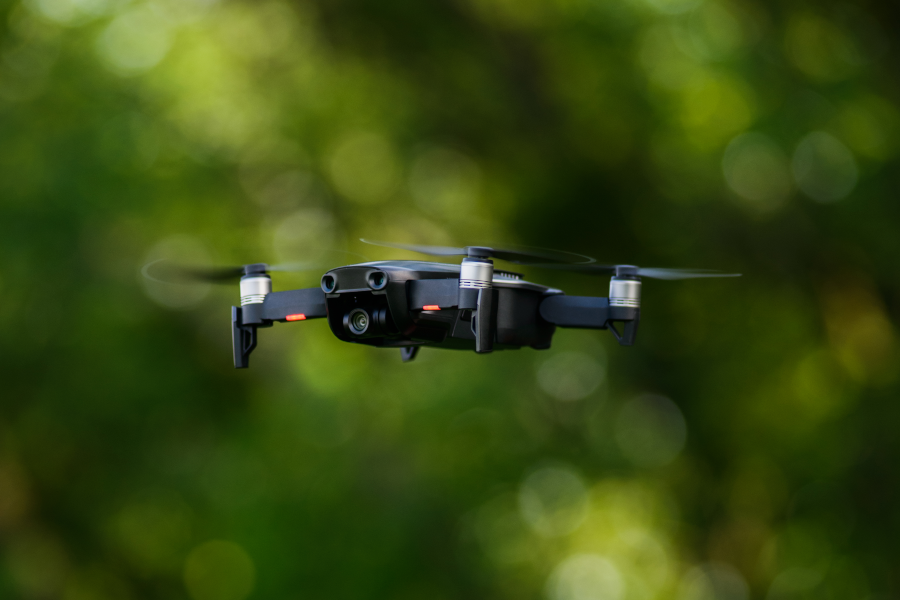
Traditionally limited to recreational use or audiovisual recording, drones have now seen widespread adoption across diverse industrial sectors. According to the UAV Drones Market Size 2025 report, this integration is driven by a 49% increase in agricultural applications and a 41% rise in demand for industrial inspections. These unmanned aerial vehicles (UAVs) are now critical assets, providing access to hazardous environments, reducing personnel risk, and executing high-speed monitoring and exploration tasks.
Despite these advancements, reliable operation in real-world scenarios remains a challenge. To function autonomously in strategic areas, drones must withstand "uncertain conditions," such as volatile weather patterns or wireless communication failures.
Addressing this gap between theory and practical application, the University of Santiago de Chile was recently awarded a Fondequip grant from the National Agency for Research and Development (ANID). The project, titled "Platform for Unmanned Aerial Vehicles to Study Dynamic Systems with Uncertainty in the Mobile Network Paradigm," is led by Dr. Rafael Ángel Orellana. He is joined by telecommunications experts Dr. Karel Toledo and Dr. Sandy Bolufé from the School of Engineering to develop resilient UAV systems capable of navigating the complexities of modern mobile networks.
“This project marks a definitive turning point,” explains Dr. Rafael Orellana. “Previously, much of our research was confined to theoretical or simulated models, leaving a persistent need for a reliable platform to validate our proposals. In peer-reviewed publications, the question was always: ‘Does this work experimentally?’ We are now positioned to make that qualitative leap.”
The newly acquired infrastructure—the Autonomous Vehicles Research Studio—is a comprehensive hardware ecosystem designed to manage drone swarms. More than just a collection of aircraft, the studio features a sophisticated safety environment with specialized netting and flooring, as well as a high-precision Motion Capture (MoCap) system utilizing 12 tracking cameras. An advanced control station serves as the brain of the operation, allowing researchers to toggle between manual joystick navigation and fully automated control to coordinate flight and communication across multiple units simultaneously.
“The study of uncertainty in dynamic systems has been our central focus for years,” adds the professor from the Department of Electrical Engineering. “In the field, drones encounter uncontrolled variables—from sudden wind gusts and signal interference to data transmission latency. This project integrates dynamic systems modeling with communication channel modeling, creating a physical environment where we can study these variables in the real world, rather than just on paper.”
Moving beyond the laboratory, this project serves as a critical enabler for real-world applications. By automating tracking and localization within a controlled environment, the initiative directly supports mining operations, agricultural monitoring, and security surveillance—sectors where autonomous systems must respond reliably to unforeseen challenges.
Beyond technical benchmarks, the project is a catalyst for interdisciplinary collaboration and the cultivation of advanced human capital. This framework strengthens a growing academic network dedicated to robotics and automation across Chile.
“There is already significant interest from researchers at the Federico Santa María Technical University (USM) and Adolfo Ibáñez University (UAI) who work with compatible technologies,” notes Dr. Orellana. “This allows us to maximize our equipment's potential through joint research. Most importantly, it shows students that the rigorous mathematical development—often seen as abstract equations—serves a tangible purpose. Seeing a drone navigate complex conditions because of that math is what truly transforms their education.”